
That was almost three times as much as what businesses producing and refining oil in the United States made in the same period in 2025.
By Rebecca F. Elliott and Keith Collins
Oct. 30, 2026, 6:35 a.m. ET
The war with Iran has been very lucrative for American oil companies, which have earned more than $130 billion in profit as people pay much higher prices for gasoline, diesel and other fuel.
That is a conservative estimate based on the performance of more than 50 large U.S. oil and gas companies, most of them producers or refiners, in the six months from April through September. It does not reflect profits earned in March, the first month of the war, or in October.
These companies earned less than $47 billion collectively during the same period in 2025, a challenging stretch when oil was cheaper and companies were navigating the early fallout from President Trump’s trade war.
The blockbuster oil profits this year highlight longstanding concerns about who gains, and who pays the price, when wars interrupt the flow of energy. As of this week, Americans had spent an extra $147 billion on gasoline and diesel since the United States and Israel began striking Iran on Feb. 28, according to an analysis by Brown University’s Climate Solutions Lab. That amounts to more than $1,100 per household.
Some companies are benefiting more than others. U.S. refiners have fared especially well because fuel-making plants have been badly damaged by hostilities in the Middle East and Russia. With fewer refineries available to meet global demand, profit margins soared for those that remain online.
Refining Company Profits
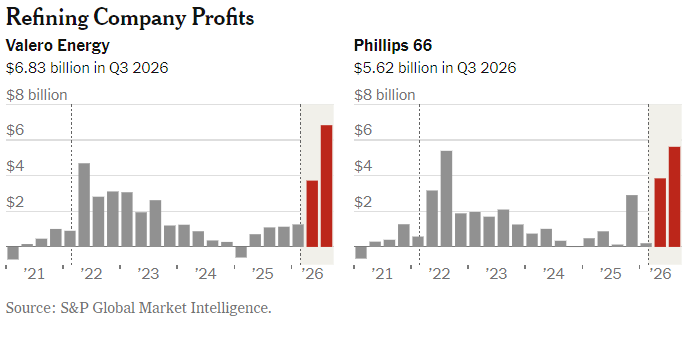
Source: S&P Global Market Intelligence.
U.S. Oil Industry Earned Over $130 Billion in Profit During Iran War – The New York Times
The wartime boom has extended to American producers, most of which are reaping greater income from higher prices without having to contend with the danger or cost of operating in conflict zones. That said, their profits generally remain below 2022 levels, when Russia’s invasion of Ukraine caused oil and natural gas prices to soar. U.S. oil prices averaged around $90 a barrel from April through September of this year, compared with roughly $100 during the same period in 2022.
Exxon Mobil and Chevron, the biggest U.S. oil companies, reported their highest third-quarter earnings in years on Friday, buoyed by their refining businesses.
“We certainly acknowledge that the higher fuel prices put pressure on families and businesses,” Neil Hansen, Exxon’s chief financial officer, said in an interview. “But this is one of those situations and type of business where you can’t invest your way out of these conditions overnight. The decisions that matter today were made years ago.”
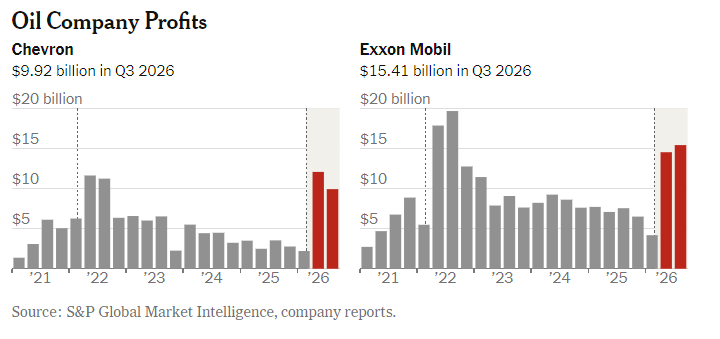
Exxon’s third-quarter profit more than doubled. Chevron’s almost tripled.
“The cash is going on the balance sheet,” said Eimear Bonner, Chevron’s chief financial officer. “That’s an asset that obviously we lean on in hard times and we strengthen in times when we see higher prices.”
Dozens of other U.S. oil companies will report third-quarter results in the coming weeks. The New York Times analysis relied on a combination of financial results and, if those were not yet available, analyst estimates compiled by FactSet, a financial data firm. The review did not extend to pipeline companies or service providers, whose performance has been less directly affected by the global oil shock.
For now, many companies are following a similar playbook, paying down debt and parking their extra cash rather than investing in producing more oil than they originally planned or expanding refining capacity.
“We’re not going to change our approach to capital investments just because we have a lot of cash,” Homer Bhullar, chief financial officer of the refining giant Valero Energy, told Wall Street analysts last week. Valero’s third-quarter profit soared more than sixfold.
“Over time, all the excess cash we’re accumulating will ultimately be directed toward our owners,” Mr. Bhullar said. He did not discuss specifics, but that usually involves increasing dividends or buying back company stock.
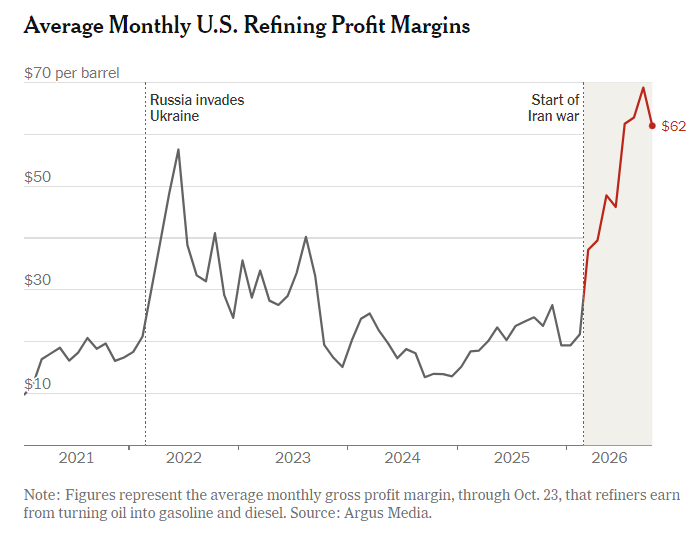
U.S. refiners have performed especially well because a lot of the oil they process is delivered by pipeline, insulating them from sky-high shipping costs. These companies are a vital link between oil producers and consumers because they transform the crude oil that is pumped from the ground into usable fuels like gasoline and diesel. Some companies, such as Exxon and Chevron, produce oil and refine it, but many specialize in just one of those businesses.
Large European companies reported bumper profits, too. Shell earned $12.06 billion in the third quarter, more than doubling its profit from a year earlier, partly because refining was so lucrative. The French oil major TotalEnergies’ third-quarter profit also more than doubled, to $8.26 billion.
United Refining, a privately held fuel maker in western Pennsylvania, plans to use this year’s windfall to pay down debt, said John Catsimatidis, the company’s chief executive and a longtime Trump ally. Or, perhaps, to buy a new corporate plane.
“I am serious,” Mr. Catsimatidis said in an interview. “You know why? I’m 78 years old. If I don’t buy a new airplane now, when am I going to buy it? When I’m dead?”
Lisa Friedman contributed reporting.
Rebecca F. Elliott covers energy for The Times.
Keith Collins is a Times visual reporter and editor in the Graphics department.